- SOUN surged 10.55% on April 15 after stacking three enterprise partnerships across telecom, insurance, and healthcare.
- Trailing revenue hit $168.9M, up 68% YoY. The company remains unprofitable with negative asset returns.
- CFO Nitesh Sharan exits April 2026. Co-founder James Hom steps in as interim. Governance overhang persists.
P/S Ratio: 17.3x — Net Loss Ongoing
SoundHound AI closed near $7.70 on April 15, up from a late-March base around $6.03. Three partnerships drove the move. First, the Experis EXCELERATE AI deal makes SOUN the exclusive conversational AI partner for Experis in the U.S., with an initial wedge into healthcare. Second, Mexican insurer Quálitas expanded its deployment to roughly 100,000 calls per month, up 150% since 2022, automating end-to-end claims handling. Third, Associated Carrier Group opened SOUN’s agentic AI platform to Tier 2 and Tier 3 telecom operators — a segment with high call volume and limited incumbent competition.
These are not letters of intent. They are operational deployments with measurable throughput. The Quálitas number in particular matters: it converts the AI narrative into a utilization metric that a skeptic can stress-test. The ACG deal traded down roughly 3.6% on announcement day, which reflects macro risk appetite, not deal quality. The Experis print produced a 3.9% gain on its own. The market is scoring individual catalysts, which is exactly what you want to see in a momentum name building institutional legitimacy.
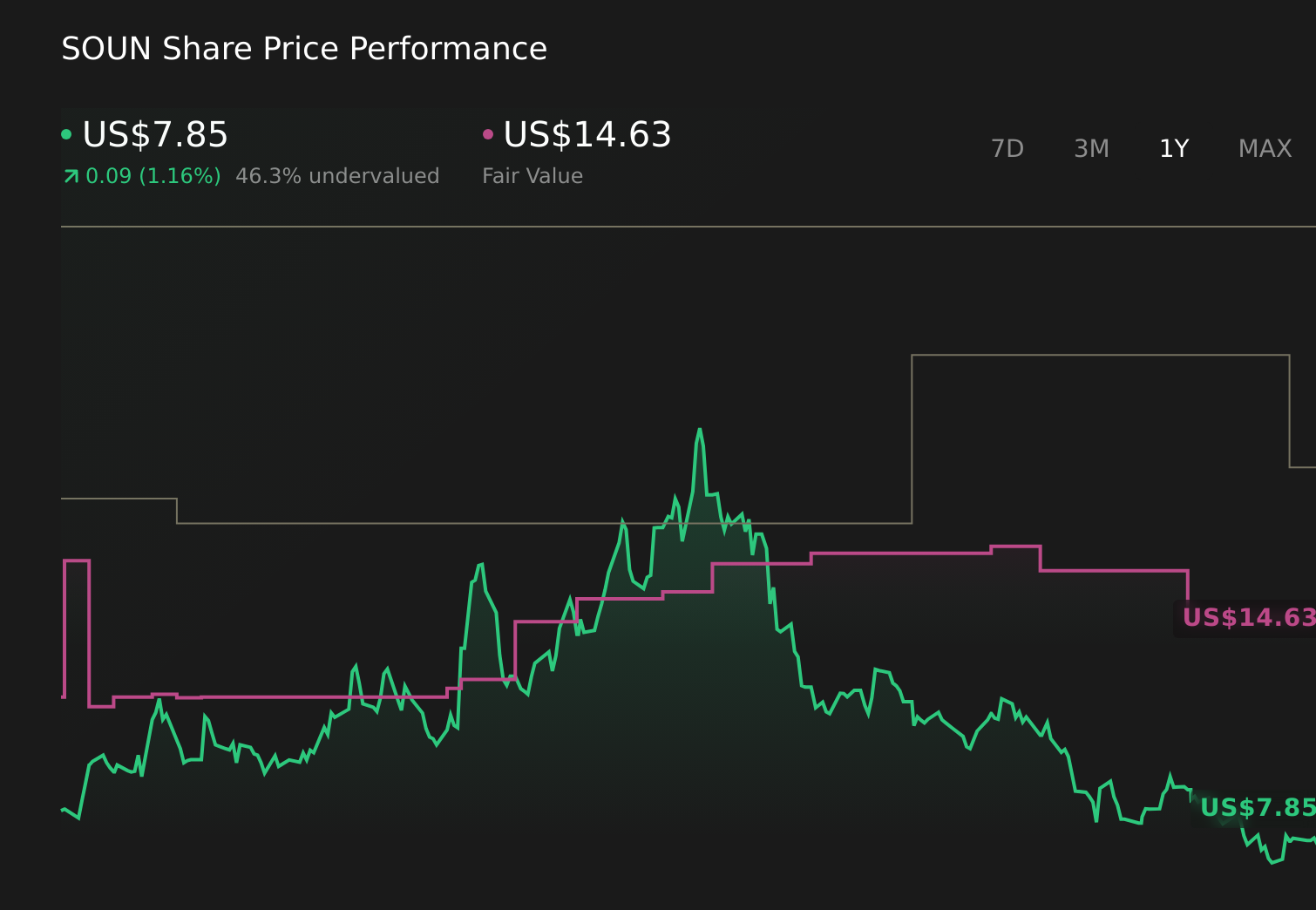
The bull case rests on a clear model: agentic AI as sticky infrastructure across high-volume service verticals. The Quálitas and ACG deployments demonstrate that thesis in production. One published fair value estimate puts SOUN at $14.62, implying roughly 86% upside from current levels, based on projected 2029 revenue of $264.9M and a swing to $30.2M in earnings. That requires 16.2% compounded annual revenue growth from here and a $44.2M earnings improvement off a base of -$14.0M today.
The math is achievable but unforgiving. Gross margin sits at 42%, which is workable, but cash burn and equity dilution remain the structural drag. A P/S of 17.3x and P/B above 6x price in aggressive execution. The current ratio of 4.6 and low debt give the company runway, but every quarter without a path to operating breakeven tightens the narrative. The upcoming multimodal Agentic+ automotive platform, previewed at NVIDIA GTC 2026, adds another vertical. It also adds another execution dependency. SOUN is betting that breadth compounds faster than burn.
The CFO departure is not a footnote. Nitesh Sharan leaving in April 2026 removes a key capital markets interface at exactly the moment the company needs to defend its premium multiple to institutional buyers. James Hom is a co-founder, which carries credibility internally. It does not replace continuity for investors modeling cash flow timelines.
SOUN has done something most small-cap AI names fail to do: it converted a single-vertical origin story into multi-industry production deployments with real utilization data behind them. The stock earns its momentum designation. The valuation, however, prices in near-perfect execution through 2029 with no margin for deal slippage or extended losses. The CFO transition is an unresolved variable that institutional holders will scrutinize on the next earnings call. This is not a value entry. It is a growth-momentum position that lives and dies on quarterly revenue acceleration and contract retention rates.
Watch Item: SOUN’s next quarterly earnings print — specifically whether Quálitas, ACG, and Experis deployments begin translating into recurring revenue line items, and what guidance the interim CFO provides on cash burn trajectory.
Disclaimer: This post is for informational purposes only and does not constitute investment advice. All investment decisions and their outcomes are solely the responsibility of the reader.