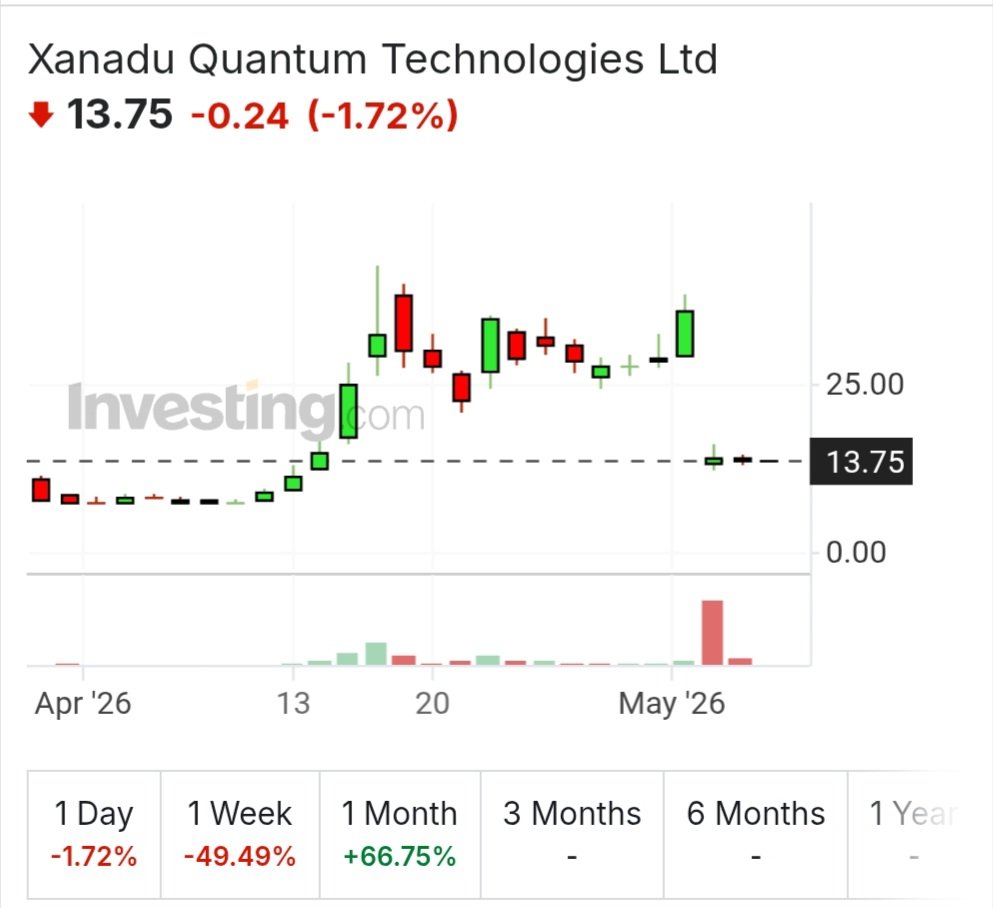
- XNDU crashed ~60% after filing to register 293.6 million Class B shares for resale.
- Shares are SPAC conversion, private placement, and founder stock — not a new capital raise.
- Despite the drop, XNDU remains up 36% year-to-date in 2026.
-60% Single Session
Xanadu Quantum Technologies filed a prospectus with the SEC to register up to 293.6 million Class B subordinate voting shares for resale. The market read it as a dilution event and sold first. The stock hit approximately $14.46 intraday — its lowest print since mid-April.
The filing is not a new equity offering. Xanadu receives zero proceeds. The shares originate from three buckets: roughly 254.7 million from the conversion of Class A shares tied to the Crane Harbor Acquisition Corp. SPAC merger that brought Xanadu public on March 27; 27.5 million from a prior private placement; and 7.33 million founder shares plus approximately 3 million held by legacy investors. A de minimis 157,960 shares sit behind RBC warrants that would generate cash to the company only upon exercise.
This is standard SPAC mechanics. Lock-up expiry and resale registration filings are contractual obligations negotiated at deal close, not surprise capital raises. The $302 million raised in the merger is already on the balance sheet. Retail traders on Stocktwits called the move an overreaction. On the raw structure, they are not wrong — but float expansion of this magnitude is not consequence-free.
Xanadu’s technology sits in the photonic qubit camp. Bank of America has outlined seven claimed advantages: room-temperature operation, manufacturability, error correction flexibility, modularity, networkability, fast clock speeds, and telecom compatibility. Those are real differentiators versus superconducting approaches from IBM and Google — on paper. Fault-tolerant, commercially viable quantum hardware remains years out across the entire sector.
Sector context matters here. Quantum computing equities have been a momentum-driven trade since Alphabet’s Willow chip announcement in late 2024 sparked a broad rally. That momentum has decayed. Jensen Huang walked back his bearish commercialization timeline, but competitive pressure from Nvidia, Google, and IBM has not eased. Xanadu’s near-term revenue base is government contracts and academic research — the same thin revenue profile that defines peer Infleqtion, which also went public via SPAC earlier this year.
The Canadian government funding angle — up to C$390 million combined from Ottawa and Ontario — provides a floor narrative, but those are talks, not committed capital. Until that funding closes or Xanadu posts a commercialization milestone, the stock trades on sentiment and float technicals, both of which just got materially worse.
The sell-off is mechanically overdone — no new dilution capital left the company. But 293.6 million newly tradeable shares entering a thin post-SPAC float is a structural headwind that does not resolve in a single session. XNDU still carries a 36% YTD gain; there is plenty of cost basis above current levels ready to exit into any bounce. The photonic thesis is credible long-term, but commercialization timelines are speculative and the company runs on government funding. This is a show-me story, not a buy-the-dip story.
Watch Item: Confirmation or rejection of the C$390 million Canadian government funding commitment — any official announcement date or term sheet disclosure moves the stock materially.
Disclaimer: This post is for informational purposes only and does not constitute investment advice. All investment decisions and their outcomes are solely the responsibility of the reader.